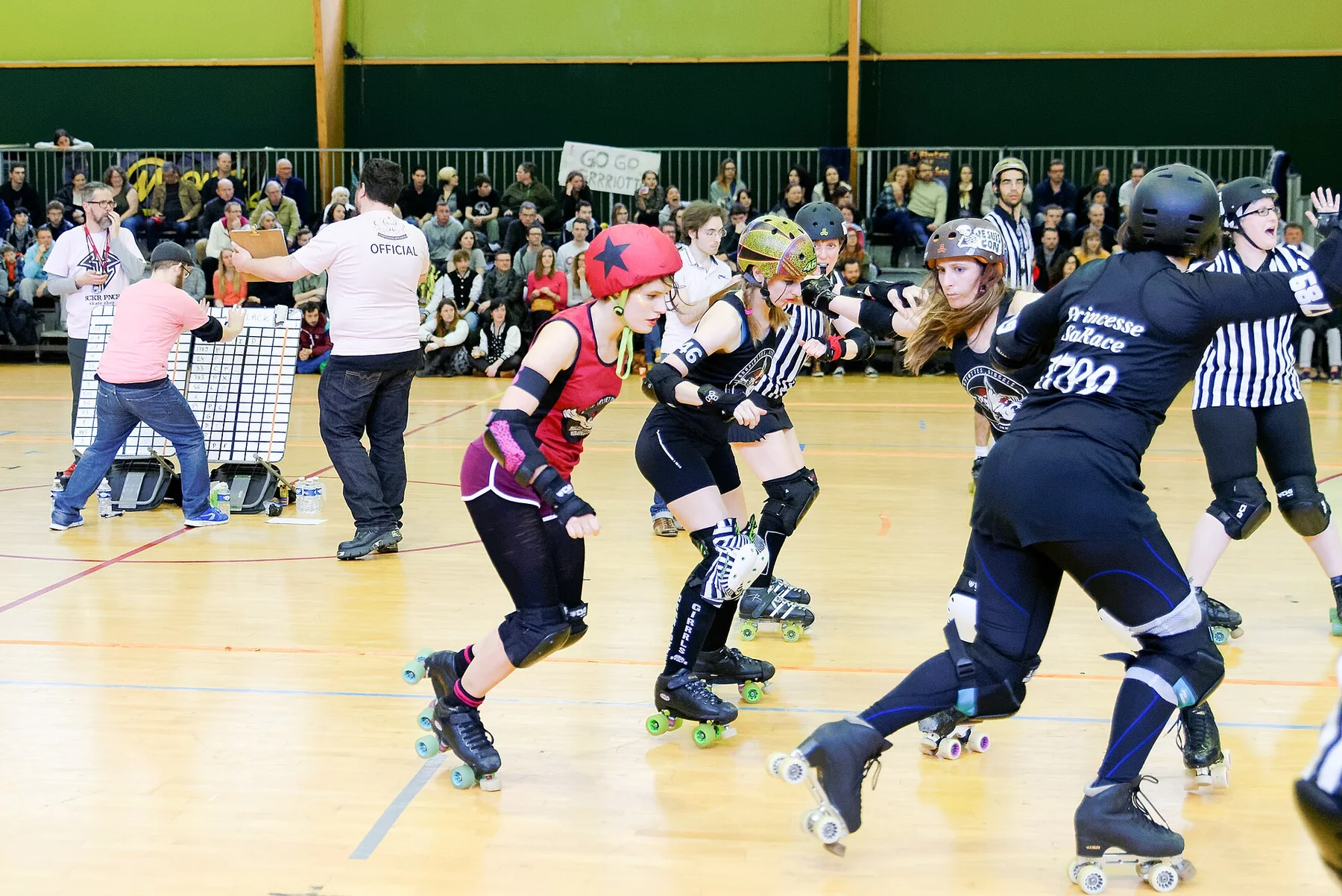
Watch the relationship between both teams’ blockers. The pack is defined by their positions, not by where a coach wishes they were or where most of one team is standing.
Eight blockers are not automatically one pack.
The pack is the largest group of upright, in-bounds blockers in proximity that contains skaters from both teams. Proximity means no more than ten feet to the nearest pack skater ahead or behind. Jammers do not determine the pack.
If two separate qualifying groups have the same size, neither wins the definition. There is no pack. The same is true if no group meets the conditions at all. A cluster containing only one team cannot declare itself the pack because it has the most bodies.
Distances are measured along the track, parallel to the inside boundary, between skaters’ hips. A line drawn straight across the infield would answer the wrong question.
Twenty feet ahead. Twenty feet behind.
The engagement zone extends twenty feet in front of the foremost pack skater and twenty feet behind the rearmost. That is the area where blockers may engage or be engaged, subject to the other blocking rules. It travels with the pack.
A blocker beyond that area is out of play. The blocker must act to return when warned. That explains a moment which can otherwise look strange to a new spectator: a blocker stops pursuing a jammer who has escaped far enough ahead.
Jammers are allowed to leave the engagement zone. They need that freedom to make their trip around the track. It does not make every action they take legal; boundaries, contact zones and the other rules still matter.
“No pack” changes everyone’s job.
When there is no pack, all blockers have a responsibility to reform it. The rear group moves forward; the front group takes the appropriate action to reduce the separation. Intentionally destroying the pack is illegal.
A no-pack call does not mean both teams should sprint away and keep blocking wherever they like. Blocking on or by blockers with impact during no pack is penalizable. The requirement to restore the game’s legal playing area is part of the sport, not a pause in it.
The exact action expected depends on the situation. The official rule and casebook resolve those details. Our diagram is an introduction for watching and discussing play, not an officiating certification exercise.
Watch the bridge, then the opening.
Once you know the definition, watch a blocker stay close enough to connect groups that might otherwise separate. That connection can preserve the pack and extend the legal area in which teammates work. Commentators often call this bridging.
Then look for the offensive decision. A team may be resisting an opposing jammer while one blocker moves to help its own. The most dramatic collision is not always the play that changes the jam; sometimes it is the space created beside it.
For your next bout, spend one jam ignoring the stars and watching only the blockers’ spacing. Return to the jammers afterward. The two views explain each other.
Go to the source.
Research and editorial explanation, not a report of attending these programs. Rules references use WFTDA 20250101. League arrangements can change; follow the current program page.