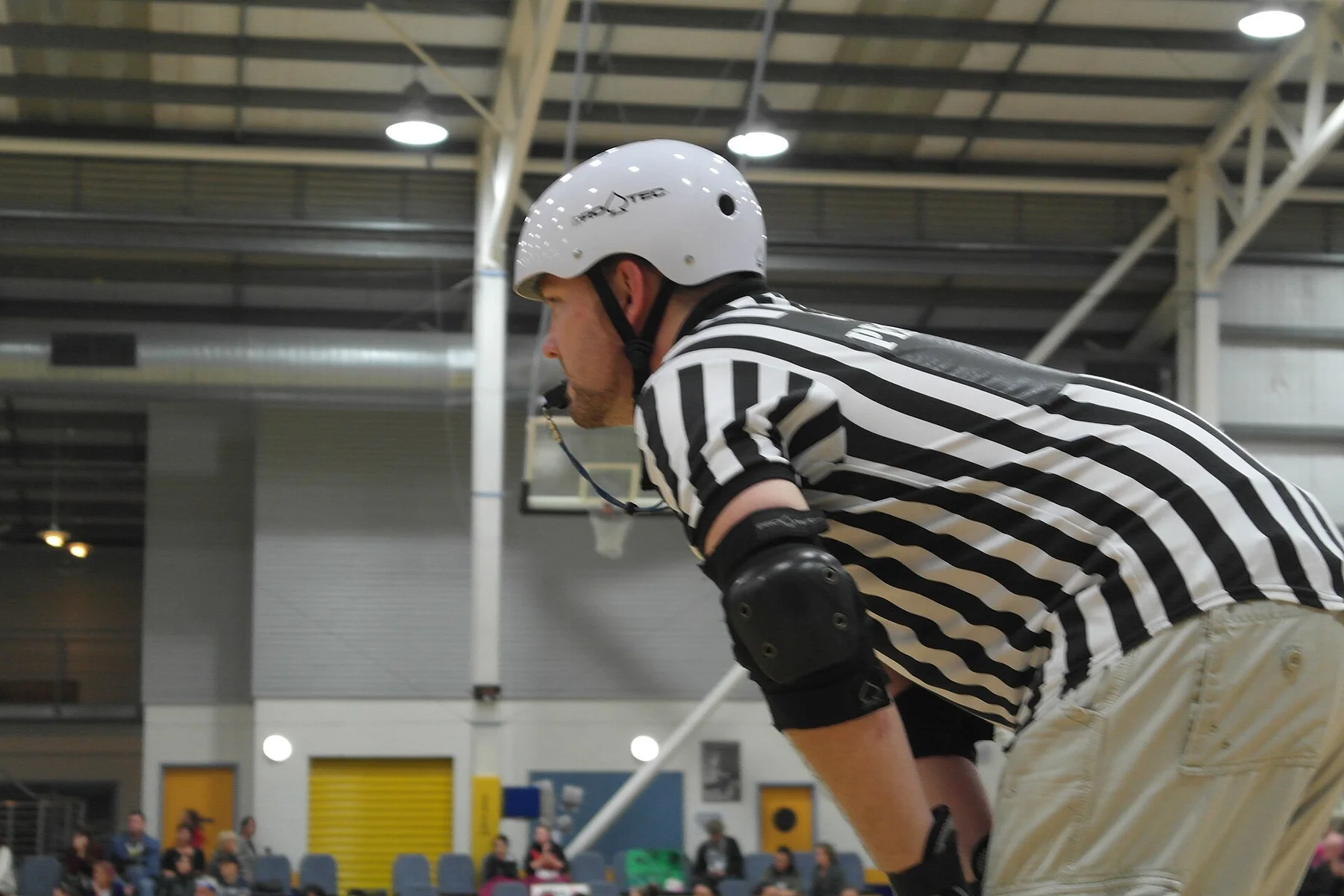
Learn the difference between where you may hit, what you may hit with, and whether you are allowed to engage at all. A big-looking collision is not a reliable penalty test.
Legal target. Legal tool.
The target zone describes where an opponent can legally be blocked. Legal targets include the chest, front and sides of the torso, arms, hands, hips, and front and sides of the legs above mid-thigh. The head, neck, back and lower portions of the legs are outside those legal target areas.
The blocking zone describes the part of the initiating skater’s body used to deliver the block. Legal tools are the torso, arms above the elbow and legs above mid-thigh. Hands, forearms and elbows are not legal tools for initiating a block.
Those two lists are deliberately different. An opponent’s arm can be a legal target, while using your forearm to initiate an impactful block is illegal. “It touched an arm” is not enough information to judge a play.
Position can make contact illegal too.
Skaters cannot initiate blocks while down, out of bounds, out of play, stopped or moving clockwise. They also cannot initiate a block on an opponent who is down, out of play or fully out of bounds. The rules distinguish initiation from absorbing contact and necessary counter-blocking.
Cutting the track is another common source of confusion. A skater returning from out of bounds must not keep an illegally gained advantage. Exactly whom they need to return behind depends on the play, including who forced them out and whether those opponents retain their advantage.
For a learner, the useful habit is to ask the coach or official what positional advantage caused the call. Trying to memorize “always return behind everyone” obscures the actual rule and its exceptions.
Thirty seconds of jam time.
A penalty normally means thirty seconds in the box, timed during jams. Time begins when the skater sits. The final ten seconds are served standing; penalty time pauses between jams.
Jammer penalties have special release rules when the other jammer also reports to the box. That means a jammer does not always serve an uninterrupted thirty seconds. When one team’s jammer is penalized and the other is available to score, spectators call the advantage a power jam.
Seven recorded penalties foul a skater out of the game. A sufficiently dangerous or unsporting action can lead to expulsion independently of that count. Those are different routes to removal, with the head referee responsible for expulsion decisions.
Learn a call by reconstructing the play.
Use the official’s signal and verbal cue as your starting point. Identify the skater, the action and its effect. A spectator usually sees only one angle, while a crew is dividing responsibilities around the track.
At training, ask for the sequence after the drill stops: where did the action begin, what made it illegal, and what would a legal alternative have looked like? That conversation is useful practice. Repeating a penalty name without understanding the trigger is not.
Use the current casebook when a situation turns on an exception. Our guide helps you follow a bout; it does not replace the officials’ procedures or a coached session for learning contact.
Go to the source.
Research and editorial explanation, not a report of attending these programs. Rules references use WFTDA 20250101. League arrangements can change; follow the current program page.