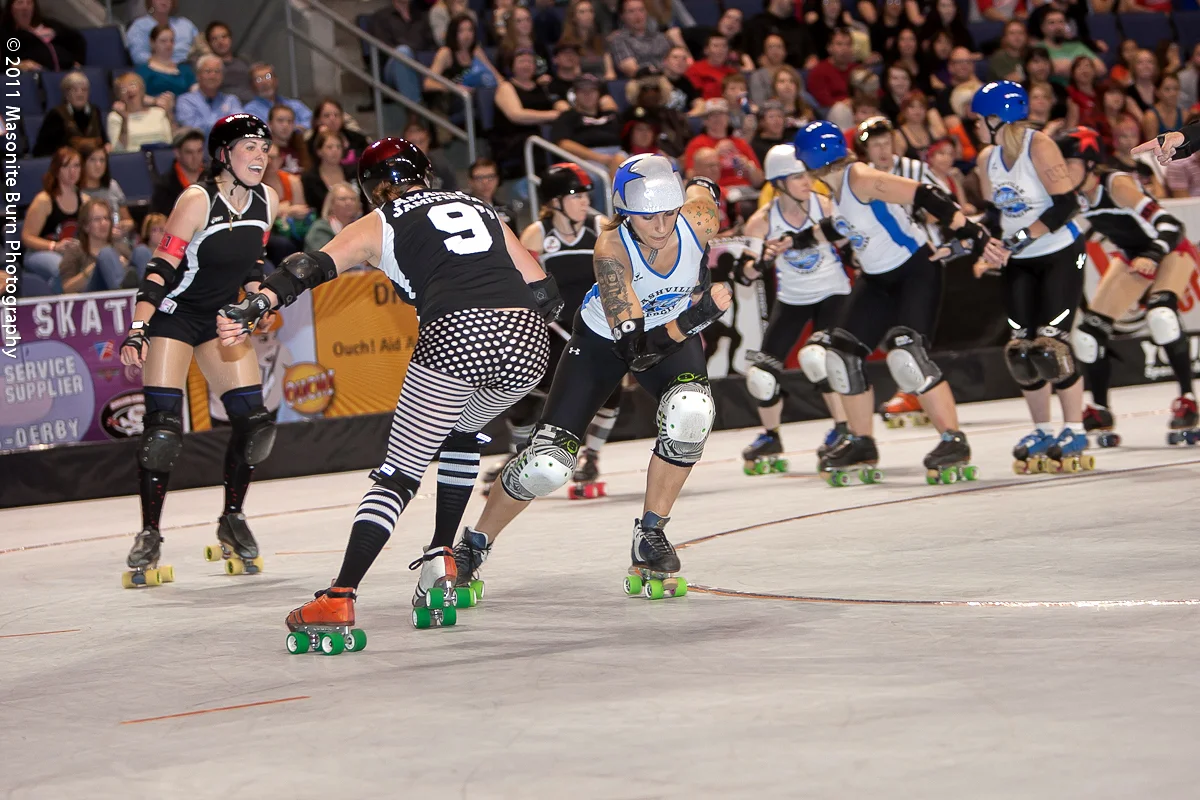
Follow one jammer for the first few jams. Once you can spot the initial trip, lead and a scoring trip, start watching how the blockers change the available space.
Find the two stars.
Each team has one jammer, identified by a star helmet cover. The other skaters are blockers; the blocker with the stripe is the pivot. In an ordinary jam, the jammers first work through the pack without scoring. They then circle the track to lap opposing blockers and score.
Choose one star and follow it. Watch where the jammer enters the group, which blockers engage, and where a teammate tries to open a route. The first eligible jammer to complete the lead requirements gets lead status. It is an officiating decision, not simply a label for whoever appears furthest ahead.
The track lab takes you through this sequence without a moving camera or an announcer using six unfamiliar terms.
Read the score, not just the speed.
Only opposing blockers yield points, one each when legally lapped. A normal complete scoring trip is worth four. A team can score on more trips within the same jam, so four is not a maximum jam score. Passing the other jammer does not add a fifth point.
Lead can call the jam early with repeated hands-to-hips motions. That is why a jammer may score four and stop a play while looking perfectly capable of continuing. If the other jammer is about to score, ending the jam can protect the advantage.
Keep the overall game score separate from the points just earned in this jam. Some displays show both. When a jam ends, the officials still need to communicate and record the points; watch the next lineup while that happens.
Know which clock you’re watching.
A WFTDA game has two 30-minute periods. A jam can last up to two minutes, with 30 seconds between jams unless a timeout interrupts the sequence. The period clock normally continues between jams; it is not a series of separately timed two-minute games.
If the period clock expires during a jam, that jam continues until its normal end. A timeout or official review can make the wall-clock evening longer than 60 minutes. Buy tickets for the whole event rather than planning to leave exactly one hour after the first whistle.
Overtime is a special case: both jammers can score on their initial trip and neither can earn lead. The ordinary sequence in our track lab intentionally leaves overtime out.
Be a useful person in the room.
Use the venue’s seating instructions, especially around the track edge and official areas. A floor seat may carry different age or access conditions from the stands. If you need an accessible seat or a quieter spot, ask the league before buying the ticket.
Cheer for the work as well as the hit: a blocker holding a line, a teammate opening a lane, or a jammer choosing a smart call-off. Don’t enter the track or penalty-box area to make a point. Officials are doing jobs that can be hard to follow from a single seat.
After the game, check the league’s recruitment and volunteer routes. A good first question is simply where beginners start. It is much more useful than assuming the next public bout is an open practice.
Go to the source.
Research and editorial explanation, not a report of attending these programs. Rules references use WFTDA 20250101. League arrangements can change; follow the current program page.